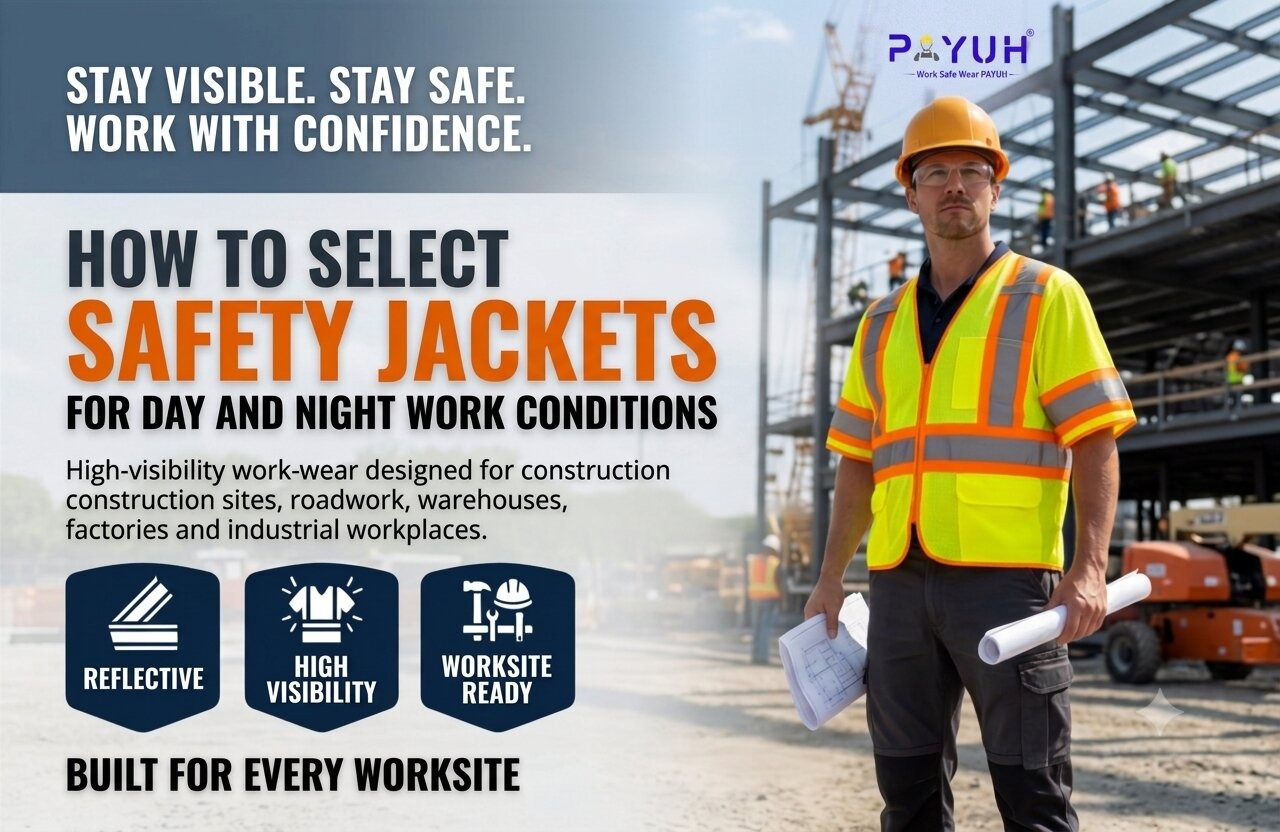
Workplace visibility is a critical consideration for businesses operating in construction, roadwork, logistics, manufacturing, warehousing, infrastructure, and other industrial environments. Workers may be exposed to moving vehicles, heavy equipment, low-light areas, traffic, and changing weather conditions. Choosing the right safety jacket can help improve worker visibility and support a more organized workplace safety program.
However, not every safety jacket is suitable for every working condition. A jacket designed for daytime outdoor work may not provide the same visibility characteristics required for night shifts or poorly lit environments. B2B buyers therefore need to consider factors such as high-visibility materials, reflective strips, jacket color, work environment, weather, comfort, durability, sizing, and applicable safety requirements before placing bulk orders.
For businesses purchasing safety jackets in large quantities, selecting the right product is not simply about choosing the lowest price. The objective should be to identify safety apparel that matches the actual working conditions while providing practical value, durability, and consistent quality across the workforce.
A safety jacket is an important part of high-visibility workwear. Its primary purpose is to make workers more noticeable against their surroundings, particularly where vehicles, machinery, or other hazards are present.
This becomes especially important when employees work:
For procurement managers and contractors, the correct jacket can also contribute to standardized employee workwear. Ordering the same type of high-visibility apparel across a project can make workers easier to identify and can create a consistent professional appearance.
Day Work vs. Night Work: What Changes?
One of the most important factors when selecting safety jackets is the difference between daytime visibility and nighttime visibility.
During daylight, the color and contrast of the jacket can play an important role in helping workers stand out from their surroundings. Fluorescent or high-visibility colors are commonly used because they can provide strong visual contrast in many daytime environments.
At night, however, simply wearing a bright-colored jacket is not enough. A worker may be difficult to see when there is insufficient ambient light. This is where retroreflective material becomes particularly important.
Retroreflective strips are designed to return light toward its source, such as vehicle headlights. This can make a worker more noticeable when illuminated by approaching vehicles or equipment.
Therefore, businesses operating both day and night shifts should evaluate jackets according to the visibility requirements of each working condition.
For daytime outdoor work, jacket color is an important consideration.
Common high-visibility jacket colors include:
The appropriate color depends on the workplace environment and the contrast needed between the worker and their surroundings.
For example, workers operating around greenery, construction materials, machinery, or road infrastructure may require a color that creates sufficient visual contrast against the background.
For B2B buyers, it is useful to assess the actual worksite before selecting a jacket color. A color that performs well in one environment may be less visually distinct in another.
For night shifts and low-light conditions, reflective elements are a major consideration.
A high-visibility jacket may include reflective strips positioned around the:
The arrangement of reflective material can influence how easily a worker's presence and body shape can be recognized from different directions.
Businesses should consider where workers will be positioned and how vehicles or machinery will approach them. For example, road crews and warehouse personnel may need visibility from multiple directions.
When purchasing safety jackets in bulk, buyers should examine the quality, placement, width, and coverage of reflective material instead of evaluating the jacket based solely on its base color.
Learn more: https://payuh.in/blog-how-reflective-jackets-keep-us-safe-in-the-dark-16.php
If your workforce operates across different shifts, selecting separate jackets for every shift may not always be practical.
A day-and-night high-visibility safety jacket can combine fluorescent material with reflective components, making it suitable for a broader range of working conditions.
This type of jacket can be particularly useful for:
For procurement departments, a versatile jacket can also simplify inventory management when the same workwear needs to be distributed across multiple shifts.
There is no universal safety jacket that is ideal for every industry.
Before purchasing, identify where the jacket will actually be used.
Construction Sites
Construction workers may encounter dust, debris, machinery, vehicles, and changing weather. Jackets should therefore be selected with visibility, durability, comfort, and practical use in mind.
Road and Highway Work
Road workers may operate close to moving traffic. High visibility and reflective features are particularly important in environments where workers need to remain noticeable to drivers and equipment operators.
Warehouses and Logistics
Warehouse workers may operate around forklifts, loading equipment, trucks, and storage systems. Jackets should provide visibility without restricting movement.
Manufacturing Facilities
Manufacturing environments can involve machinery, industrial processes, and restricted work zones. Safety apparel should be selected according to the facility's specific hazards and workwear requirements.
Outdoor Night Operations
Workers operating after sunset or in poorly illuminated areas should have appropriate reflective elements and high-visibility features suited to their work conditions.
A safety jacket can provide useful visibility, but workers are more likely to wear workwear properly when it is comfortable and practical.
For B2B buyers, consider:
This becomes particularly important for employees who wear safety jackets for eight or more hours a day.
An uncomfortable jacket may create unnecessary distractions or encourage workers to remove or improperly wear their protective clothing.
Weather should also influence your purchasing decision.
For hot environments, lightweight and breathable safety jackets may be more appropriate. In colder conditions, businesses may need heavier jackets or high-visibility outerwear that can be worn over additional layers.
Depending on the workplace, buyers may also need to consider protection from:
For businesses operating throughout the year, it may make sense to maintain different types of high-visibility jackets for seasonal conditions rather than relying on one product for every environment.
B2B safety apparel needs to withstand repeated use.
When comparing safety jackets, examine the quality of:
A jacket that looks good when new may not provide the same value if its reflective components or stitching deteriorate quickly under regular workplace use.
For bulk buyers, durability is especially important because replacing hundreds or thousands of jackets can significantly increase the total cost of ownership.
Businesses can choose from several types of safety jackets depending on their operational requirements.
High-Visibility Safety Vests
Lightweight safety vests are useful where workers need visibility without significant additional warmth or coverage.
Reflective Safety Jackets
These jackets combine high-visibility materials with reflective strips and can be suitable for workplaces where workers may encounter low-light conditions.
High-Visibility Winter Jackets
These can provide visibility while offering additional protection against colder working conditions.
Waterproof or Weather-Resistant Safety Jackets
For outdoor operations exposed to rain or wet conditions, weather-resistant options may be considered.
Multi-Pocket Safety Jackets
These can be useful for workers who need to carry small tools, identification cards, communication devices, or other work-related items.
The correct option depends on the job, environment, climate, and company's workwear requirements.
Safety jackets are often worn as part of a larger PPE system.
Before placing a bulk order, check whether the jacket can be comfortably worn with other workplace equipment such as:
The jacket should not interfere with the proper use of other required PPE.
Ordering safety jackets in only one or two sizes may seem convenient, but poor fit can affect comfort and usability.
For B2B procurement, prepare a size requirement based on the actual workforce.
Consider maintaining an appropriate range such as:
S – M – L – XL – XXL – XXXL
The exact size range should depend on the workforce and supplier availability.
For large projects, businesses should ideally confirm measurements and sizing before placing a full-scale order.
Safety apparel requirements can vary depending on the workplace, location, industry, and applicable regulations or standards.
Procurement teams should identify the relevant requirements for their specific application and verify the manufacturer's product specifications and documentation before purchase.
Do not assume that every brightly colored jacket qualifies as compliant high-visibility protective clothing.
When evaluating suppliers, ask for relevant technical information, product specifications, and compliance documentation where applicable.
For B2B buyers, the supplier is just as important as the product.
A reliable safety jacket supplier should be able to provide:
This is especially important for contractors managing large projects. If the same jacket needs to be reordered several months later, consistency in design, color, material, and reflective features can be valuable.
Before placing an order, procurement teams can use the following checklist:
Common Mistakes When Buying Safety Jackets in Bulk
Choosing Based Only on Price
The cheapest jacket may not necessarily provide the best long-term value. Procurement teams should consider durability, visibility, comfort, and expected usage.
Ignoring Night-Time Requirements
A bright jacket may be suitable for daytime visibility but may not provide the reflective characteristics needed for low-light work.
Buying Without Checking Samples
For large orders, reviewing product samples before committing to the entire quantity can help buyers assess fabric, fit, color, reflective material, and construction.
Ordering the Wrong Sizes
Poorly fitting workwear can reduce comfort and usability. Collect workforce size requirements before finalizing the order.
Ignoring the Work Environment
A lightweight vest, winter jacket, waterproof jacket, and standard high-visibility jacket serve different purposes. Match the product to the actual working conditions.
Focusing Only on the Jacket and Not the Supplier
For large-scale procurement, consistent availability and dependable delivery can be just as important as product specifications.
Businesses purchasing safety jackets regularly should approach procurement systematically.
Start by identifying the number of workers, working locations, shifts, weather conditions, and hazards. Next, determine whether workers require daytime visibility, nighttime visibility, or both.
After identifying these requirements, shortlist suitable jacket types and request product specifications and samples. Compare quality, sizing, reflective features, durability, delivery capabilities, and pricing.
For recurring projects, maintain a standardized specification so future orders can be placed with greater consistency.
This approach can help businesses avoid unnecessary purchases and select workwear based on actual operational requirements rather than simply choosing the most readily available product.
For contractors, industrial companies, logistics operators, and infrastructure businesses, safety jackets are often purchased in significant quantities. The supplier must therefore be capable of meeting both product and procurement requirements.
PAYUH INDUSTRIES provides safety and industrial products for businesses looking for practical solutions for workplace requirements. When sourcing safety jackets, B2B buyers can evaluate available options according to visibility needs, working conditions, product specifications, quantity requirements, and project requirements.
Whether the requirement is for reflective safety jackets, high-visibility jackets, industrial safety jackets, or other safety workwear, businesses should select products based on the environment in which employees will actually use them.
Selecting a safety jacket for day and night work requires more than choosing a bright-colored garment. Businesses need to consider visibility, reflective features, working conditions, weather, comfort, durability, sizing, PPE compatibility, applicable requirements, and supplier reliability.
For daytime work, high-visibility colors and strong contrast can be important considerations. For nighttime or low-light work, appropriate reflective elements become especially important. For organizations operating across multiple shifts, a suitable combination of fluorescent and reflective features may provide a practical solution.
For B2B procurement teams, the best purchasing decision starts with understanding the work environment. Once the requirements are clearly defined, businesses can compare safety jacket types and suppliers more effectively and build a workwear program that supports their broader workplace safety practices.
Looking for safety jackets for your workforce or bulk industrial requirements? Explore safety workwear options from PAYUH INDUSTRIES and discuss your specific quantity, application, and product requirements with the supplier.
Visit website and check our products: https://payuh.in/category-body-protection-1.php
#SafetyJacket #ReflectiveSafetyJackets #PAYUHINDUSTRIES